

How To Open Oven After Self Clean
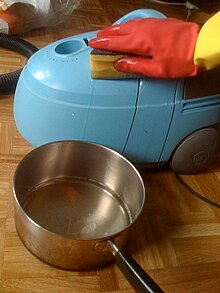
Using a mix of acidic vinegar and soap to clean a plastic surface
Cleaning agents or difficult-surface cleaners are substances (ordinarily liquids, powders, sprays, or granules) used to remove clay, including dust, stains, bad smells, and ataxia on surfaces.[1] Purposes of cleaning agents include health, beauty, removing offensive odor, and avoiding the spread of dirt and contaminants to oneself and others. Some cleaning agents tin can kill leaner (e.g. door handle leaner, as well as bacteria on worktops and other metallic surfaces) and clean at the aforementioned time. Others, called degreasers, incorporate organic solvents to aid deliquesce oils and fats.[2]
Chemical agents [edit]
Acidic [edit]
Acidic cleaning agents are mainly used for removal of inorganic deposits like scaling. The agile ingredients are normally strong mineral acids and chelants. Often, surfactants and corrosion inhibitors are added to the acid.
Hydrochloric acid is a common mineral acid typically used for concrete. Vinegar can too be used to clean hard surfaces and remove calcium deposits that also helps to maintain our environment bacteria gratuitous. Sulphuric acid is used in acidic bleed cleaners to unblock clogged pipes past dissolving greases, proteins, and even saccharide-containing substances such as toilet tissue.
Alkaline metal [edit]
Alkaline cleaning agents contain strong bases similar sodium hydroxide or potassium hydroxide. Bleach (pH 12) and ammonia (pH eleven) are mutual element of group i cleaning agents. Ofttimes, dispersants, to prevent redeposition of dissolved dirt, and chelants, to assault rust, are added to the alkaline agent.
Alkali metal cleaners can deliquesce fats (including grease), oils, and protein-based substances.
Neutral [edit]
Neutral washing agents are pH-neutral and based on not-ionic surfactants that disperse dissimilar types.
Scouring agents [edit]
Scouring agents are mixtures of the usual cleaning chemicals (surfactants, water softeners) as well equally annoying powders. The abrasive pulverisation must exist of a uniform particle size.
Particles are usually smaller than 0.05 mm. Pumice, calcium carbonate (limestone, chalk, dolomite), kaolinite, quartz, soapstone or talc are often used equally abrasives, i.e. polishing agents.
Special bleaching powders incorporate compounds that release sodium hypochlorite, the classical household bleaching agent. These precursor agents include trichloroisocyanuric acid and mixtures of sodium hypochlorite ("chlorinated orthophosphate").
Examples of notable products include: Ajax, Bar Keepers Friend, Bon Ami, Comet, Vim, Zud, and others.
Purposes [edit]
Oven cleaners [edit]
Traditional oven cleaners contain sodium hydroxide (lye), solvents, and other ingredients,[3] and piece of work all-time when used in a slightly-warm (not hot) oven. If used in a self-cleaning oven, the lye will cause permanent damage to the oven.
New-manner oven cleaners are based on ingredients other than lye. These products must be used in a cold oven. Nearly new-mode oven cleaners can be used in cocky-cleaning ovens.
Oven cleaners are some of the almost toxic household cleaning products available on the market place.[four] Correct use of an oven cleaner may be reasonably prophylactic, merely incorrect use, including breathing fumes, contact with optics and mucous membranes and swallowing can cause poisoning.[5]
One popular oven cleaner brand in the Us is "Easy-Off", sold by Reckitt Benckiser. Popular choices in the United kingdom include "Zep Oven Brite" and "Mr Musculus Oven Cleaner".
All-purpose cleaners [edit]
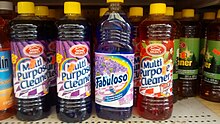
Fabuloso multipurpose cleaner and generic surface cleaners
All-purpose cleansers contain mixtures of anionic and nonionic surfactants, polymeric phosphates or other sequestering agents, solvents, hydrotropic substances, polymeric compounds, corrosion inhibitors, skin-protective agents, and sometimes perfumes and colorants.[six] Aversive agents, such equally denatonium, are occasionally added to cleaning products to discourage animals and small children from consuming them.
Some cleaners contain water-soluble organic solvents like glycol ethers and fatty alcohols, which ease the removal of oil, fat and paint. Disinfectant additives include quaternary ammonium compounds, phenol derivatives, terpene alcohols (pine oil), aldehydes, and aldehyde-amine condensation products.
All-purpose cleaners are usually concentrated solutions of surfactants and h2o softeners, which enhance the beliefs of surfactant in hard water. Typical surfactants are alkylbenzene sulfonates, an anionic detergent, and modified fatty alcohols. A typical h2o softener is sodium triphosphate.
All-purpose cleansers are effective with virtually common kinds of dirt. Their dilute solutions are neutral or weakly element of group i, and are safe for utilise on virtually surfaces.
Dishwashing agents [edit]
Manual dishwashing detergent [edit]
Automatic dishwashing detergents (ADDs) [edit]
Laundry detergents [edit]
Floor cleaners [edit]
Rug cleaners [edit]
Toilet cleaners / hygiene / deodorant products [edit]
Toilet bowl cleaning often is aimed at removal of calcium carbonate deposits, which are attacked by acids. Powdered cleaners contain acids that come in the form of solid salts, such as sodium hydrogen sulfate. Liquid toilet basin cleaners contain other acids, typically dilute hydrochloric, phosphoric, or formic acids. These catechumen the calcium carbonate into salts that are soluble in water or are hands rinsed away.
Drain cleaners [edit]
Metallic cleaners [edit]
Metal cleaners are used for cleaning stainless steel sinks, faucets, metal trim, silverware, etc. These products contain abrasives (e.grand., siliceous chalk, diatomaceous earth, alumina) with a particle size < 20 μm. Fatty alcohol or alkylphenol polyglycol ethers with 7-12 ethylene oxide (EO) units are used every bit surfactants.[six]
For ferrous metals, the cleaners contain chelating agents, abrasives, and surfactants. These agents include citric and phosphoric acids, which are nonaggressive. Surfactants are normally modified fat alcohols. Silverish cleaning is a specialty since argent is noble just tends to tarnish via formation of black silver sulfide, which is removable via silver-specific complexants such as thiourea.
Stainless steel, nickel, and chromium cleaners contain lactic, citric, or phosphoric acid. A solvent (mineral spirits) may be added.
Nonferrous metallic cleaners comprise ammonia, ammonium soaps (ammonium oleate, stearate) and chelating agents (ammonium citrate, oxalate).
For special type of precious metals especially those used for luxury watches and loftier-end jewelry, special type of cleaning agents are unremarkably used to clean and protect them from the Elements. Some examples of these cleaners include jewelry cleaner from Weiman,[7] lookout cleaning solution from HOROCD[eight] & even cleaning metallic plates from Holland Hallmark.
Glass cleaners [edit]
Light duty hard surface cleaners are not intended to handle heavy dirt and grease. Considering these products are expected to clean without rinsing and result in a streak-free shine, they comprise no salts. Typical window cleaning items consist of alcohols, either ethanol or isopropanol, and surfactants for dissolving grease. Other components include small amounts of ammonia equally well every bit dyes and perfumes.[ane]
These are composed of organic, h2o-miscible solvent such as isopropyl alcohol and an alkaline detergent. Some glass cleaners likewise contain a fine, mild abrasive. Well-nigh glass cleaners are bachelor as sprays or liquid. They are sprayed straight onto windows, mirrors and other drinking glass surfaces or applied on with a soft cloth and rubbed off using a soft, lint-free squeegee. A glass cloth ideal for the purpose and soft water to which some methylated spirit or vinegar is added which is an inexpensive glass cleaner.
Silverware can exist freed of silverish sulfide tarnish with thiourea, and either hydrochloric or sulfuric acrid.
Building facade cleaners [edit]
For acid-resistant building facades, such as brick, acids are typically used. These include mixtures of phosphoric and hydrofluoric acids besides as surfactants. For acid-sensitive facades such as concrete, strongly element of group i cleaners are used such as sodium hydroxide and thickeners. Both types of cleaners require a rinsing and often special care since the solutions are aggressive toward skin.
Environmental impacts [edit]
Common cleaning agents [edit]
- Acetic acrid (vinegar)
- Various forms of alcohol including isopropyl alcohol or rubbing booze
- Ammonia solution
- Amyl nitrite and other nitrites
- Bleach
- Borax
- Carbon dioxide
- Citric acrid
- Freon (due east.thou. dichlorodifluoromethane) (use is often discouraged due to damaging effects on the ozone layer)
- Soap or detergent
- Sodium bicarbonate (baking soda)
- Sodium hydroxide (lye)
- Sodium hypochlorite (liquid bleach)
- Sodium perborate
- Sodium percarbonate
- Tetrachloroethylene (dry out cleaning)
- Trisodium phosphate
- Water, the virtually common cleaning amanuensis, which is a very powerful polar solvent
- Xylene (tin damage plastics)
See likewise [edit]
- Disinfectant
- Green cleaning
- Laundry detergents
- List of cleaning products
References [edit]
- ^ a b Christian Nitsch, Hans-Joachim Heitland, Horst Marsen, Hans-Joachim Schlüussler (2005). "Cleansing Agents". Ullmann's Encyclopedia of Industrial Chemistry. Weinheim: Wiley-VCH. doi:x.1002/14356007.a07_137.
{{cite encyclopedia}}: CS1 maint: uses authors parameter (link) - ^ Wisniewski, Karen (2007). "All-Purpose Cleaners and their Formulation". In Tsoler, Uri (ed.). Handbook of detergents, Part 2. Surfactant science serial. CRC Press. ISBN978-1-57444-757-6.
- ^ Justo, Patrick Di (nineteen May 2008). "What'south Within: Foamalicious, Vaporlicious Easy-Off Oven Cleaner". Wired. Condé Nast, Inc. ISSN 1059-1028.
- ^ Kelly, John (9 June 2012). "How Cocky-cleaning Ovens Work". HowStuffWorks website. InfoSpace Holdings LLC.
- ^ https://www.mountsinai.org/health-library/poison/oven-cleaner-poisoning Oven cleaner poisoning, The Mount Sinai Wellness Arrangement, retrieved April 18th, 2021
- ^ a b Christian Nitsch; Hans-Joachim Heitland; Horst Marsen; Hans-Joachim Schlüssler (2007), "Cleansing Agents", Ullmann'due south Encyclopedia of Industrial Chemistry (seventh ed.), Wiley
- ^ Chan, Tim (thirteen May 2020). "After Washing Your Easily, Hither'southward How to Clean and Disinfect Your Watches and Jewelry". Rolling Rock.
- ^ DEBBY KWONG, HAYDEN NG. "How to take intendance of your watches and jewellery". Her World Singapore. Her Globe Singapore.

Source: https://en.wikipedia.org/wiki/Cleaning_agent
Posted by: guerradetuabove.blogspot.com
0 Response to "How To Open Oven After Self Clean"
Post a Comment